
11 Frequently Asked Questions about Tub to Shower Conversions to Save You Time, Money & Aggravation
Excerpt from article written by Mike Foti on February 8, 2021, and updated on January 2, 2022,
with comments and editing from Countersync.
You’ve (almost) convinced yourself to ditch your tub and convert to a shower. After all you never use the tub anyway. You’re also worried about your spouse falling while climbing into your tub/shower. And your tub surround and tub have seen their better days…years ago!
However, you’re still not ready to pull the trigger and replace the tub. You have questions about cost. You wonder if this project will reduce your resale value. You wonder how to design the shower, so it works –today and into the future.
You’ve visited many bathroom remodeling websites “who say they can do it in a day.”
You’d like to tell these sites, “Whoa Nellie, I have a few questions first.” You’re determined not to waste your time or money until you have clear answers to your questions about tub to shower conversions. And this is EXACTLY what this article is about.
FAQ #1 about tub to shower conversions– Will getting rid of my tub reduce my resale value?
You’ve heard the ‘age-old’ realtor wisdom you have to have a bathtub for ‘resale.’ And I’ll grant you it’s ‘safer’ to have one bathroom with a tub to check the ‘home has a tub box’ before listing your home. However, I’ll also tell you it really depends on who(m) the target market is for your home. If your market is young families with small children, then a tub is a must. If your market is 50+ couples – the exact opposite logic applies. The shower will be preferred.
FAQ #2 about tub to shower conversions– How much is the installed cost of a tub to shower conversion?
Just like your Dad used to say you’re ‘not made of money!’ And you don’t want to invest a lot of time researching a tub to shower conversion if it’s out of your budget.
And while I could give you the ‘cop-out’ answer the installed costs of a tub to shower conversion project depends on a lot of variables (including what materials you choose, local labor rates and if you need to make significant changes in the plumbing) that doesn’t help you one ‘iota’ (whatever the heck an iota is).
So, here’s what I will tell you. Most installed tub to shower conversion companies will give you a free estimate, so it’s best to follow that path before you sign on the dotted line.
FAQ #3 about tub to shower conversions– Now that I’ve given you the bad news about costs, you may be wondering how you can save money on this project?
Whether you’re looking to DIY your tub to shower conversion, or have it professionally installed, here’s 5 money-saving tips you can use to keep a lid on costs.
Money-saving tip #1 – Don’t move the plumbing. Moving plumbing has a major impact on cost (especially if you have a concrete floor or have a joist located exactly where you’d like the drain to go). Keep costs down by installing your new shower where your old tub was.
Money saving tip #2 –Use grout free walls vs. ceramic tile – A tile shower adds a lot of cost if you’re having this project professionally installed.
Money saving tip #3 – Use a solid one-piece shower pan vs. a tile shower floor – A professionally installed tile shower floor pan is time consuming vs. the simplicity of a one-piece pan. With a Solid Surface shower pan you’ll also get one which is as solid as a rock.
FAQ #4 about tub to shower conversions– How long does it take to complete this project?
For a professionally installed tub to shower conversion allow 2 to 3 days for completion (note: this will include the installation of new plumbing valve, shower head and a glass enclosure with shower wall surround panels). On the other hand, if you do a tile shower add 3 or 4 more days.
(However, the true answer is – It depends, especially if you are replacing flooring, cabinets, lighting fixtures, painting, etc…..
FAQ #5 about tub to shower conversions– How can I reduce the chance of mold and mildew in my new shower?
Perhaps there’s no time in our lives where we understand the negative impacts of bacteria than today. Living through a pandemic is something most of us (certainly me included) never even considered.
However, understanding the negative impact of bacteria is one thing but developing strategies to minimize bad bacteria is another.
So, what can you do to reduce this problem in your bathtub to shower conversion?
The simplest way is to get rid of grout joints. These would be grout joints in your shower pan and shower walls.
Look at stylish grout free products like Solid Surface. They’re maintenance free. They keep the mold and mildew out.
FAQ #6 about tub to shower conversions– I’d like seating in my new shower, what’s the best option?
I’m asked all the time about installing bench seats in a tub to shower conversion and I’ll tell you what I tell others….
I’m not a fan of bench seating in tub to shower conversions!
And you may be wondering what I’ve got against bench seating. Well – I don’t like how they eat 20-25% of the shower space. And I don’t like how they require more expensive glass packages since the glass has to ‘climb over’ the tub deck (see what I mean from this stylish – yet expensive – system below).
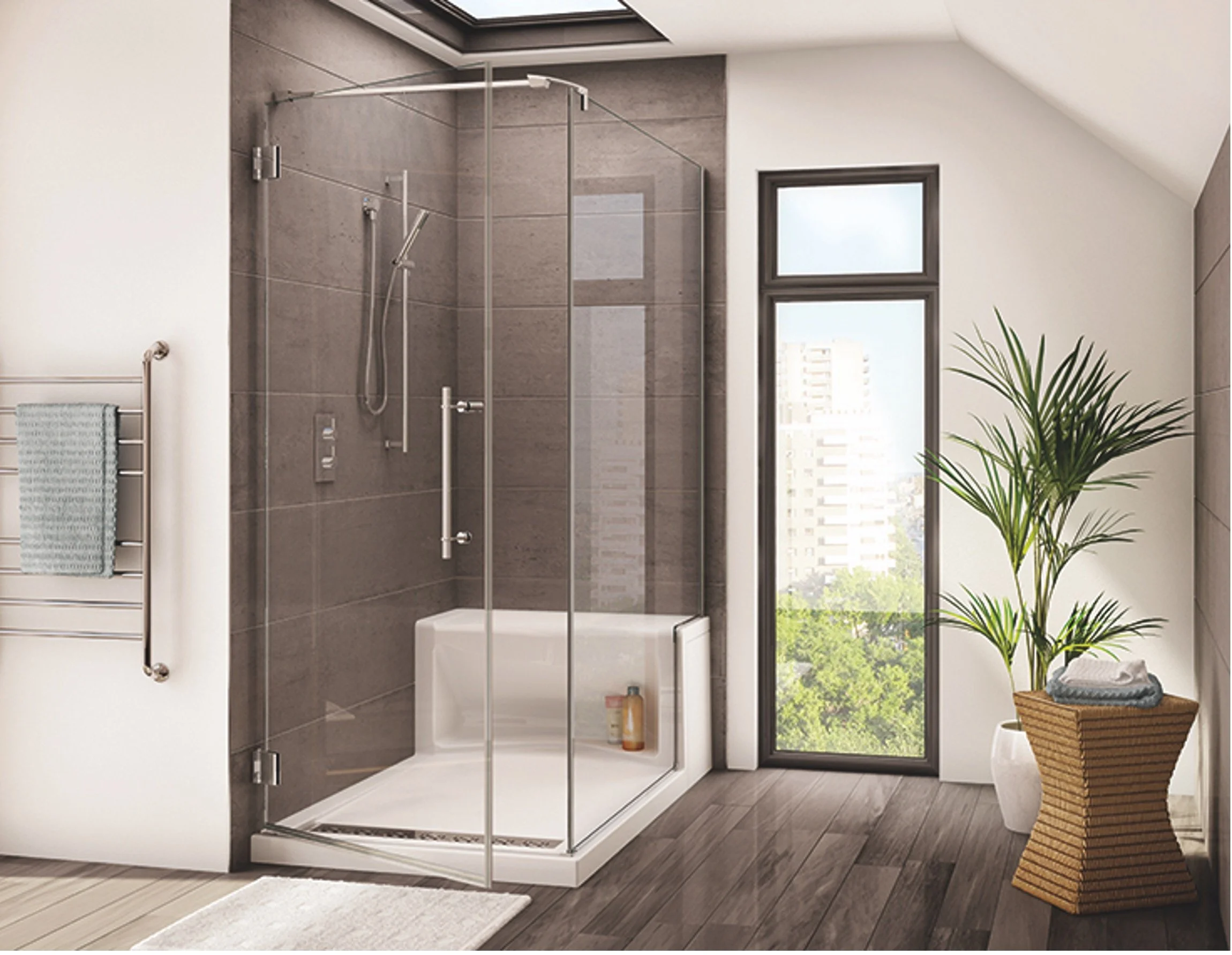
OK – you may be saying, “I NEED seating in my new shower to shave my legs. I need seating so my Mom can sit while showering. I need some type of seating!” I get it. I get it. And I’ve got a better solution than a bench seat for you.
The corner seat – It takes far less room, yet still gives you seating.
FAQ #7 about tub to shower conversions– I hate contractors in my home (especially now). How can I reduce the amount of time this job takes?
Every ‘non-delusional contractor’ knows even if you love us, you really don’t want us in your home. Let’s face facts….
Contractors are an imposition. They get in the way of living freely in your home. And if you have a touch of O.C.D. you might chime in and say… remodeling is messy.
So, how can you make sure the time to do a tub to shower conversion is as short as possible BEFORE your contractor starts kicking up dust? Here’s 4 ideas:
Idea #1 – Make sure the materials are on site BEFORE the project begins. Make sure everything is in good condition.
Idea #2 – Make sure your contractor is experienced. Hiring the cheapest rookie contractor you can find to save a few bucks is a recipe for disaster.
Idea #3 – Discuss with your contractor (before the project begins) what the plan would be if they find a rotten subfloor, or there’s mold behind the walls. How would these problems be handled? How would they impact the schedule? Have these conversations BEFORE a problem occurs.
Idea #4 – Use materials which are time-effective to install like Solid Surface.
FAQ #8 about tub to shower conversions– I’d like to convert my tub to a walk-in shower. What’s the best way to make sure the water stays inside the shower and doesn’t end up on the bathroom floor?
Cleaning water from your bathroom floor not only isn’t fun, but it can cause leaks in the floor, in the room below. Water outside the shower is not good.
So, if you’re looking to convert to a walk-in shower you need a game-plan to keep the water in the areas of your bathroom which are waterproofed. But how? Here’s 2 strategies to keep your ‘head above water’.
Strategy #1 – Choose the right shower head(s) – Look for shower heads which won’t spray water outside the shower opening. One option is to use a rain head which is directed down vs. a stationary shower head which is spraying at you. Another is a hand-held shower.
Strategy #2 – Choose the right curb height for your shower pan and make sure your shower pan slopes all water to the drain.
FAQ #9 about tub to shower conversions– Is it best to build a ceramic tile shower or use grout free shower wall panels?
While you can inject a HUGE amount of creativity into a tile shower, they’re a pain to maintain, take a long time to build, are prone to leaking and expensive.
Personally, I’m a big fan of grout free walls.
FAQ #11 about tub to shower conversions– Why am I better off with a shower than a tub?
If you’ve read the previous 10 frequently asked questions and you’re still uncertain about why a shower is better than a tub, consider these benefits.
Showers are safer to walk into (and can keep your loved ones out of the hospital).
Showers use less water. It’s estimated a 10-minute shower uses 25 gallons of water vs. filling a tub requires 35 to 50 gallons.
You’ll have more space in the shower vs. the tub.
Showers are easier to clean.
Few people use a tub anymore.
So, now that you’ve read the 11 frequently asked questions about tub to shower conversions are you ‘sold’ they’re right for you?
My goal with this article was to make your decision clearer if a tub to shower is right for you. So, after reading this article – are you sold converting your bathtub into a shower is a good idea? And – equally as important, are you confident where to get practical (and honest) answers to your questions about this project.